Author Archives: Captain C

$DEBUG – the safer alternative to Debug

Probably one of the most annoying issues that developers encounter is distributing programs to customers that contain unintentional ‘Debug’ statements. These are often left in from testing, and, with the pressure of deadlines to deliver, they are very easy to overlook.

In order to help alleviate this issue OpenInsight 10 implements a “$DEBUG” statement that you can use in place of the normal “Debug” statement: The difference here is that the debugger only triggers if the code is running on the same machine that it was compiled on, so if your program does manage to escape with a compiled $DEBUG statement it shouldn’t execute on other machines.

There are two variations of $DEBUG. The first is a simple “$DEBUG” statement like so:

Write Record To hFile, Key Else
// Failed etc...
$DEBUG
End

The second type of $DEBUG statement behaves in the same manner as described above, but also includes the ability to define a simple expression to test, and will only trigger the debugger if the test is met (This is similar to the way that the $ASSERT statement works). For example:

// Only debug if x is equal to 3
$DEBUG( x == 3 )

$DEBUG can be used in any version of OpenInsight 10 with the following caveats:

  • From version 10.2.3 onwards the raw workstation name (e.g. “REVWS07” ) is used to test if the debugger should execute.
  • Prior to this (version 10.2.2 and earlier), the entire contents of @station is used to test. The issue here is that @station usually includes the OpenInsight process ID (e.g. “REVWS07_45383” ) so it will only debug within the instance of OpenInsight that it was compiled on. This can be a little too restrictive unless you are willing to recompile your programs after restarting your application, hence the change for version 10.2.3 mentioned above.

Note that you can also disable $DEBUG statements when compiling, in which case the debug tests are never included in the object code.  To do this simply use the NODEBUG token with the #define statement like so:

#define NODEBUG

So, hopefully you can use the $DEBUG statement for your test debugging and have a smoother experience with your customers!

The new Scan Repository tool

OpenInsight 10.2.3 brings a much needed update to the venerable Scan Repository tool, providing an updated user interface, full support for new repository types, and some new methods for problem detection and repair. In this post we’ll take a look at each of these areas in more detail, and how the various options work when repairing your system.

A new user interface

The Scan Repository tool is accessed from the IDE main menu via the Tools\Repository menu item and then choosing the “Scan Repository For Errors” option (or alternatively by executing the RTI_IDE_SCAN_REP form via the System Monitor). Users of previous incarnations of the Scan Repository tool will notice an immediate change in the user interface as it is no longer a “wizard” style UI, but now shows all of the scanning options, progress information and results on a single form instead:

The new Scan Repository tool
The Scan Repository Tool

Using the scanner is a simple process:

  • Ensure the Scan Prerequisites are met.
  • Choose the Scan Options.
  • Click the “Analyze” button to begin the scan. Progress information will be shown at the top of the form and the scan can be cancelled at any point.
  • Review the results and, if necessary, select the appropriate repair action. These appear in dropdown lists in the “Action” column of the results table and can be one or more of the following options (depending on the error):
    • Add
    • Delete
    • Ignore
  • Make sure that the items you want to fix are highlighted (selected) in the list (Remember to use the context menu to help with the selection process!).
  • When ready click the “Process” button to begin the repair process.
  • Review the repair results.
    • Note that some repairs may not be able to be completed automatically. In this case the corresponding action item may change to an “Edit” button so that the problem item can be fixed manually.
    • Details of errors encountered during the repair process are shown in a tooltip when the mouse is hovered over a problem item.

Scan Prerequisites

Repairing errors in your repository involves possible changes to some fundamental system components, so the following requirements must be met before the scan can take place:

  • Ensure that you have backed up your system and check the “A recent backup is available” check box.
  • Ensure that all others users are logged out of your system, otherwise the scan cannot proceed. The details of other logged-in users will appear in the Users list to help identify them.

Scan Options

There are two categories of scanning options. The first, “Types and Classes”, scans the core repository records to ensure that they are all correct, while the second category, “Entities” scans the normal application components.

Scanning for Types and Classes

The functionality of the repository is based heavily on the information contained in the following three locations, so it is essential that these items are correct:

  • REPFAMILY entities (SYSREPOSTYPEFAMILIES records)
  • REPTYPE entities (SYSREPOSTYPES records)
  • REPCLASS entities (SYSREPOSCLASSES records)

These are referred to as FTC entities (Family/Type/Class). They can be one of two types:

  1. “Known” – these are the FTC entities are that are supplied by Revelation.
  2. “Custom” – these are non-Revelation FTC entities added by developers that have been marked as valid in a previous “Types and Classes” scan (When an “unknown” FTC entity is first encountered in a repository scan it can be flagged as “custom” so it is considered valid in subsequent scans – see the “Unknown” class of errors in the table below).

Verify Repository Types and Classes

The state of the FTC entities can be validated by checking the “Verify Repository Types and Classes” box which ensures that this process takes place before any other normal entities are checked.

Checks performed during this scan include:

  • All known FTC entities are present and not missing any critical information.
  • All custom FTC entities which have been flagged as valid are not missing any critical information.
  • All other FTC entities that are not flagged as custom are reported as “Unknown” so they can be reviewed.

The Verify Repository Types and Classes scan can produce the following errors:

ErrorDESCRIPTION
Missing Known Type Family,
Missing Known Type,
Missing Known Class
One of the known FTC entities is missing. The default version can be added back into the system using the “Add” action.
Unknown Type Family,
Unknown Type,
Unknown Class
An unknown FTC entity has been found. It can be added as a custom type using the “Add” action, or removed using the “Delete” action. Items that have been added are marked as custom and treated as a valid FTC type in future scans.
Missing Repository RecordThe raw FTC body record is missing a corresponding SYSREPOS header record. A default SYSREPOS record can be created using the “Add” action.

(Note: OpenInsight repository entities are usually comprised of two components: A “header” record in the SYSREPOS table, and a “body”. The latter can be a record in a table or an OS file depending on the type of entity).
Bad Repository Sub-keyThe SYSREPOS header record for the FTC entity has an invalid SUBKEY entry. The “Add” action may be used to correct this.
Missing Title,
Missing Icon,
Missing Image,
Missing Type Family,
Missing SCM Format,
Missing SCM Include,
Missing Storage Type,
Missing Location,
Missing RDK Extract Type,
Missing Key Format,
Missing Designer Tool
The FTC body record is missing some required information.

If this is a known FTC entity then the “Add” action may be used to reset the missing value to its default setting.

If this is a custom FTC entity the “Add” action will switch to an “Edit” button, which opens the entity for editing in the IDE.
Missing Event ClassA custom event (added via the Event Designer tool) is missing a corresponding SYSEPOSCLASSES record. The “Add” action may be used to add a default record.

Reset to default values

Selecting this option ensures that all known Revelation-supplied FTC entities are reset to their default values during the scan. This option can be used to ensure that your repository is always in a good state.

Scanning Entities

This part of the process scans the rest of the repository based on the options chosen:

OptionDescrIPTION
Scan for missing entity headersScans a set of core tables looking for missing repository header (SYSREPOS) records.

Due to the fact that it can allow “lost” entities to be readded to the repository it is recommended that this option be run before any others.

If this option is selected all of the other Entity scanning options will be disabled.
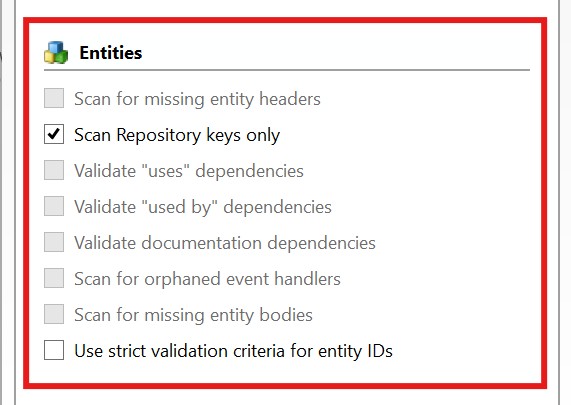
Scan repository keys onlyOnly checks the validity of repository header (SYSREPOS) keys and does not check the state of the entity itself.

The only other option allowed with this selection is “Use strict validation criteria for entity IDs”.
Validate “uses” dependenciesEnsures any entities flagged as “used” by the entity being scanned actually exist. If they don’t the link is automatically removed.
Validate “used by” dependenciesEnsures any entities flagged as “used-by” by the entity being scanned actually exist. If they don’t the link is automatically removed.
Validate “documentation” dependenciesEnsures any documentation entities linked to the entity being scanned actually exist. If they don’t the link is automatically removed.
Scan for orphaned event handlersEvent entities (source and executable) are checked to ensure that they are linked to their parent forms, and that the parent forms actually exist.
Scan for missing entity bodiesValidates that each repository entity has a corresponding body record or OS file as appropriate.
Use strict validation criteria for entity IDsValidates that keys in the SYSREPOS table conform to a limited set of characters.

When the “Scan for missing entity headers” box is checked the Entities scan can produce the following errors:

ErrorDescription
Orphan – Missing SYSREPOS [<id>]An entity body record is missing a corresponding SYSREPOS header record. The “Add” action may be used to add a default header record, the “Delete” action may be used to delete the orphaned body.
Orphan – Bad App [<id>]An entity body record is linked to a non-existent application ID. The “Delete” action may be used to delete the record (and any associated SYSREPOS header record).
Orphan – Suspected Bad App [<id>]Due to the polymorphic nature of the records in some tables (primarily SYSPROCS and SYSOBJ) it is not always possible to accurately determine what type of record is being checked.

This error can be raised in such circumstances, and the “Delete” action may be used to remove the record in question.

However, it is advised that you review the record in question before you delete it!
Orphan – Bad Key Format [<id>]A known type has a badly formatted key. The “Delete” action may be used to remove the record in question.

When the “Scan for missing entity headers” box is not checked the Entities scan can produce the following errors:

ERRORDescription
Bad KeyThe entity has a badly formatted SYSREPOS key. The “Delete” action may be used to remove the entity.
Bad AppThe APPID of the SYSREPOS key refers to an invalid application ID. The “Delete” action may be used to remove the entity.
Bad TypeThe TYPEID of the SYSREPOS key refers to an invalid SYSREPOSTYPES type ID. The “Delete” action may be used to remove the entity.
Bad ClassThe CLASSID of the SYSREPOS key refers to an invalid SYSREPOSCLASSES class ID. The “Delete” action may be used to remove the entity.
Deprecated EventAn entity has been found for a class of event that is no longer supported in version 10. The “Delete” action may be used to remove the event in question.
Strict TestThe SYSREPOS header key failed the “strict” test and is considered to be badly formatted. The “Delete” action may be used to remove the entity.
No locationThe SYSREPOS header record is missing a required location (e.g. an IMAGE type is missing the location of the OS image file). The “Delete” action may be used to remove the entity.
No BodyThe entity is missing a body record or OS File as determined by its type. This can happen if the body record exists but is null, or the ACCESS method returns null. The “Delete” action may be used to remove the SYSREPOS header record.
No Body <FSError>The entity’s body record cannot be accessed because of a filing system error. The “Delete” action may be used to remove the SYSREPOS header record.
Open ErrorA table open error occurred when checking a DBTABLE type entity. The “Delete” action may be used to remove the SYSREPOS header record.
Orphan – Missing FormAn event script entity is referring to a form entity that does not exist (i.e. there is no SYSREPOS header record for the form). The “Delete” action may be used to remove the event entity.
Orphan – Missing Form BodyAn event script entity is referring to a form entity whose body record does not exist (i.e. there is no SYSREPOSWINS or SYSREPOSWINEXES record for the form). The “Delete” action may be used to remove the event entity.
Orphan – Missing ControlAn event script entity is linked to a control that does not exist on the form. The “Delete” action may be used to remove the event entity.
Orphan – Event Not LinkedAn event script entity has been found for a control or form that does exist but it is not linked to it. The “Add” option may be used to create the link, or the “Delete” action may be used to remove the event.

(Note: Please review the control and event in question before you decide to add it as there may be a good reason that it is no longer linked!)
Orphan – Missing Script ExeAn event script debug-table entity has no corresponding event script executable entity. The “Delete” action may be used to remove the event script debug-table entity.
Orphan – Event Cannot Be LinkedAn executable event script entity cannot be dereferenced to an owner. The “Delete” action may be used to remove the executable event script.

The Scan Repository context menu

The results list of the Scan Repository tool includes a comprehensive context menu to help with selecting the items to repair along with an export option and an easy way to view the details of a specific entity:

Menu ItemDescription
Process all itemsExecutes the specified repair action (if appropriate) for all entities in the results list.
Process selected items onlyExecutes the specified repair action (if appropriate) for all selected entities in the results list.
Set all items to “Add”Sets the action option of all items in the results list to “Add” (but only if they have an “Add” option).
Set all items to “Delete”Sets the action option of all items in the results list to “Delete” (but only if they have a “Delete” option).
Set all items to “Ignore”Sets the action option of all items in the results list to “Ignore” (but only if they have an “Ignore” option).
Set all selected items to “Add”Sets the action option of all selected items in the results list to “Add” (but only if they have an “Add” option).
Set all selected items to “Delete”Sets the action option of all selected items in the results list to “Delete” (but only if they have a “Delete” option).
Set all selected items to “Ignore”Sets the action option of all selected items in the results list to “Ignore” (but only if they have an “Ignore” option).
Select all itemsSelects all of the items in the results list.
Clear all selectionsUnselects all of the items in the results list.
View <entity>Attempts to open both the SYSREPOS header record and body record (if possible) for the specified entity. These are opened as “raw” records in the IDE.
Export resultsExport the contents of the results list to a CSV file.

Conclusion

The new Scan Repository tool is available in OpenInsight v10.2.3 onwards. Hopefully it will allow you to keep your repository in good shape moving forwards!

Directory Management in OpenInsight 10

Over the years there have been several different and disparate ways of managing directories in OpenInsight, and not all of them fully documented. In this post we’re going to take look at the “official” preferred methods, along with a mention of the deprecated ones too.

Preferred methods

  • The FILESYSTEM object (for Event Context)
  • RTI_OS_Dir stored procedure (for non-Event Context)

Deprecated methods

  • Utility stored procedure
  • RTI_OS_Directory stored procedure
  • DirExists stored procedure
  • MkDir stored procedure
  • UtilityMakeDir stored procedure
  • UtilityRemoveDir stored procedure
  • UtilityRename stored procedure

A note on directory management and context

As you may be aware, an OpenInsight application runs in one of the following contexts:

  • Event Context – This applies when your Basic+ programs are called in response to an event from a standard OpenInsight application form or control (i.e. an application managed by the Presentation Server).
  • Non-Event Context – This applies to applications that run Basic+ programs outside of the Presentation Server using the RevCAPI interface to manage an instance of RevEngine. These are usually “Inet” or O4W web applications, but also include other methods like the RevRun.exe program too.

Therefore, one of the most fundamental considerations when choosing which directory management method to use is the context in which it is called: As a rule, when running in Event Context, you should always prefer to use the FILESYSTEM object for directory management, otherwise you should choose the RTI_OS_Dir stored procedure instead.

Note that if there is a possibility that your Basic+ programs will be executed in different contexts at runtime (i.e. you share them between contexts) then you should invoke the IsEventContext stored procedure to determine which method to use.

For example, here is a simple context-aware code snippet that removes a directory:

   Declare Function IsEventContext, RTI_OS_Dir, Exec_Method
   $Insert PS_FileSystem_Equates
   $Insert RTI_SSP_Equates
   
   ErrText = ""

   If IsEventContext() Then
      // Use the FILESYSTEM object
      If Exec_Method( "FILESYSTEM", "REMOVEDIR", DirName ) Else
         ErrInfo = Get_Property( "FILESYSTEM", "FILEOPRESULT" )
         ErrCode = ErrInfo<PS_FOR_ERRORCODE$>
         ErrText = ErrInfo<PS_FOR_ERRORTEXT$>
      End
   End Else
      // Use RTI_OS_DIR
      Call Set_Status( SETSTAT_OK$ )
      If RTI_OS_Dir( "REMOVEDIR", DirName ) Else
         Call Get_Status( ErrText )
      End
   End

Using the FILESYSTEM object

The FILESYSTEM object supports the following methods to manage directories. It integrates fully with the Windows Shell and provide the best user experience in Event Context:

  • COPYDIR
  • DIREXISTS
  • GETSPECIALDIR
  • MAKEDIR
  • MOVEDIR
  • REMOVEDIR
  • RENAMEDIR

The FILESYSTEM object is fully documented here.

Using the RTI_OS_Dir stored procedure

This stored procedure was added to OpenInsight 10 to provide a non-Event Context version of the functionality exposed by the FILESYSTEM object. It supports the following methods:

  • COPYDIR
  • DIREXISTS
  • GETTEMPDIR
  • MAKEDIR
  • MOVEDIR
  • REMOVEDIR
  • RENAMEDIR

The RTI_OS_Dir stored procedure is fully documented here.

(Note that there is no direct equivalent of the FILESYSTEM GETSPECIALDIR method, due to the fact that it is very Windows-specific – the GET_SPECIAL_FOLDER stored procedure should be used instead.)

The Utility stored procedure (Deprecated)

As long-time readers of this blog will know, this stored procedure was deprecated some years ago at the outset of the OpenInsight 10 project, and it is now basically a thin wrapper around several SYSTEM and FILESYSTEM object methods. It supports the following directory management methods:

  • MAKEDIR
  • REMOVEDIR
  • RENAMEDIR

When called in Event Context each of these methods forwards the request to the FILESYSTEM object. When called outside of Event Context these methods call the following stored procedures instead:

  • UtilityMakeDir
  • UtilityRemoveDir
  • UtilityRename

See below for more details on these.

The RTI_OS_Directory stored procedure (Deprecated)

This stored procedure was deprecated in favor of RTI_OS_Dir as it is very platform specific and makes use internally of RTI_OS_Dir, Utility, and an OLE interface to the Windows Shell, making it less performant than calling those procedures directly. Like Utility it is still supported but will not be updated further with any new functionality.

DirExists stored procedure (Deprecated)

This stored procedure is a simple wrapper around the RTI_OS_Dir DIREXISTS method and so has been deprecated, but can still be used by existing code.

MkDir stored procedure (Deprecated)

This venerable stored procedure is a DLL function that calls the Windows API CreateDirectory function. It has been deprecated in favor of the RTI_OS_Dir MAKEDIR method but can still be used by existing code.

UtilityMakeDir, UtilityRemoveDir and UtilityRename stored procedures (Deprecated)

These three functions form part of the original internals of the Utility stored procedure, and use a “raw” C interface that requires explicit null-terminated strings. They are all still available to use, but are deprecated in favor of the RTI_OS_Dir MAKEDIR, REMOVEDIR and RENAMEDIR methods.

Conclusion

As you can see, version 10 has pulled together the many different historical methods of directory management and consolidated them into two entities that can be used dependent on the execution context. These should be the preferred methods of directory management in your OpenInsight applications.

(As of the time of writing the full documentation for RTI_OS_DIR and GET_SPECIAL_FOLDER is in preparation and will be available shortly. All methods described here apply to version 10.2.3 and later.)

(EDIT: Full documentation for RTI_OS_DIR and GET_SPECIAL_FOLDER is now live on the Revelation Wiki.)

ListBoxes and TreeListBoxes – Checkbox Items

A recent question on the Revelation forum touched on the subject of using checkbox items in LISTBOX and TREELISTBOX controls, and this highlighted the need to document some of the new properties in OpenInsight v10 that support this functionality. In this post we’ll take a look at how you can use these to make adding checkbox items to your controls a simple task.

In previous versions of OpenInsight adding checkboxes to items was done with “smoke and mirrors”, i.e. actual item images were used to represent the checkbox, and the control itself had no concept of a checked state for any of it’s contents. Usually, when the user clicked on the item’s checkbox image, the UPDATE method was used toggle the image from checked to unchecked and vice versa. The checked state would be obtained by looking at the image number using the LIST property. Unfortunately this technique has two main drawbacks:

  • The code for detecting the mouse clicks can be complex, and when added to the image manipulation code itself the intent of the code can become obscured.
  • The images themselves must be maintained manually and updated to match the current Windows visual styling.

In OpenInsight v10 checkbox items are supported “natively” so that the control itself knows which items are “checked” and exposes the properties described below to support this. This results in less coding and a much cleaner program. 

The CHECKBOXES property

This is a simple boolean property that can be set in the Form Designer or at runtime. Setting it to TRUE$ ensures that all items in the control are drawn with a checkbox – this is all that needs to be done to use checkbox items.

The CHECKED property

This property allows you to get or set the checked state of one or more items using an @fm-delimited dynamic array of boolean flags.

// Set the second and fourth items in the LISTBOX to checked, ensure the
// third item is NOT checked.

CheckedItems = Get_Property( CtrlEntID, "CHECKED" )
CheckedItems<2> = TRUE$
CheckedItems<3> = FALSE$
CheckedItems<4> = TRUE$

Call Set_Property_Only( CtrlEntID, "CHECKED", CheckedItems )

The CHECKED property may also be used with the index parameter to get or set the state of a single item at a time:

// Set the ninth item to checked, and uncheck the tenth item
Call Set_Property_Only( CtrlEntID, "CHECKED", TRUE$, 9 )
Call Set_Property_Only( CtrlEntID, "CHECKED", FALSE$, 10 )

The CHECKEDX property

This property is similar to the CHECKED property but only applies to TREELISTBOX controls, and gets or sets the checked state for all items in the fully expanded list. 

CHECKEDLIST property

This property returns an @fm-delimited dynamic array of item indexes that have been checked. This is an optimization property so that you don’t have to iterate over the CHECKED property to find out what has been checked.

AllCheckedItems = Get_Property( CtrlEntID, "CHECKEDLIST" )

CheckedCount = FieldCount( AllCheckedItems, @Fm )
For N = 1 To CheckedCount
 CheckedItemNo = AllCheckedItems<N>
Next

CHECKEDLISTTEXT property

This property is similar to the CHECKEDLIST property except that it returns an @fm-delimited dynamic array of text for the checked items rather than their index.

AllCheckedItemsText = Get_Property( CtrlEntID, "CHECKEDLISTTEXT" )

CheckedCount = FieldCount( AllCheckedItemsText, @Fm )
For N = 1 To CheckedCount
 CheckedItemText = AllCheckedItemsText<N>
Next

Conclusion

So that wraps up this short post on checkbox items – hopefully you’ll find them much easier to use in your v10 applications.

Bonus Trivia

The CHECKED property name is a synonym for the original OpenInsight CHECK property name, and you may use either as it suits you – Here at Revelation we prefer to use CHECKED as it feels more natural. Note that this convention applies to other controls like the CHECKBOX control too.

WEBVIEW object documentation

First released with OpenInsight v10.2, the WEBVIEW object is a control that wraps the Microsoft WebView2 Edge Browser control and allows you to embed web technologies (HTML, CSS and JavaScript) in your OpenInsight forms.

This is just a quick post to let you know that the full documentation has been uploaded and can be found here:

   495 – WEBVIEW object.pdf

Migration tool updates in OpenInsight 10.2.1

Due to a significant rise in OpenInsight migrations in the past few months and the resulting feedback, we’ve fixed several bugs in the migration tool for the next release and we’ve also made one major change which we’ll describe here.

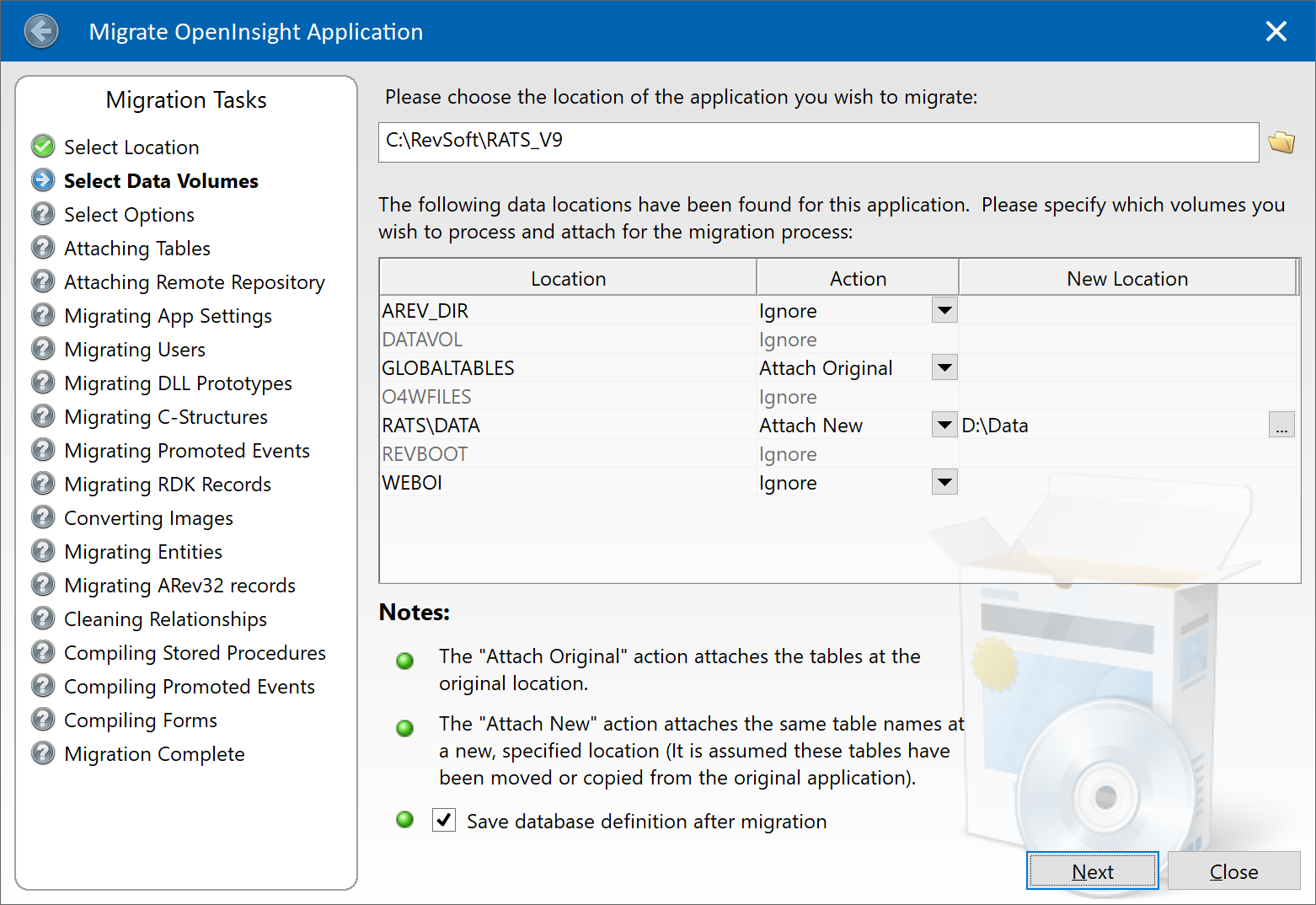
The previous migration tool post had a small note at the end called “Bonus Trivia – a quick note on migrating data” in which we recommended ignoring the option to move or copy your data tables with the tool and do it manually instead. This is still the preferred course of action, but the tool has been updated to offer more useful functionality instead: it now has the ability attach the same list of tables as your v9 system but at a different location, which should save you time when migrating an application with a large number of tables.

Attaching tables in the migration tool

OpenInsight v10.2.1 Migration Tool showing new "attach tables" option
Migration Tool Start Page

If you are familiar with previous versions of the tool you will see the following changes have been made:

  • The Move and Copy Table actions have been removed from the list of Actions
  • The “Attach” action has been renamed to “Attach Original”. This attaches the tables at their existing location as defined in your v9 application DBT file.
  • An “Attach New” action has been added. This attaches the same list of tables as the v9 application but at a different location instead. When you select this option you must specify the location in the “New Location” column.
  • A “Save database definition” check box has been added. This is enabled when you have selected at least one of the “Attach Original” or “Attach New” actions.

So, the recommended course of action for handling your tables when migrating your application for the first time is to:

  1. Move or copy your existing data tables to a new location if you wish.
  2. If your tables have been moved/copied then specify the “Attach New” action for each affected data volume and enter the new location.
  3. If your tables have not been moved then choose the “Attach Original” action instead.
  4. Check the “Save database definition” check box.

On subsequent re-runs of the tool you may simply select the “Ignore” action for your data volumes.

Hopefully this update will make migrating systems with many tables much easier for you.

Profile logging updates in OpenInsight 10.2

Previous releases of OpenInsight have included a simple logging system that records all stored procedure calls and the time taken to execute them. This logging system is enabled by creating a blank file called “RevProfile.log” in the OpenInsight directory before the application is started. If this file is present when the system boots it creates a new log file (with a name based on the application’s Windows Process ID) and writes all stored procedure activity to it until the application is stopped.

Whilst this can be a useful tool it does suffer from a few issues:

  • The log file records all activity. This usually results in very large files that are difficult to navigate and process, making them very tedious to use.
  • There is no facility to annotate parts of the log, so it can be difficult to narrow down the actual section of code that needs to be profiled.
  • The profile timing uses the classic Windows “tick count” which has a granularity of 16ms. Many stored procedures take much less time to execute than this, so entries in the log can be wildly inaccurate, usually appearing as “0ms” or “16ms”.
  • There are no tools to actually parse the log so that it can be analyzed more easily.

With this release of OpenInsight we have provided some new functionality to address these issues, namely:

  • The “RevProfileLog” function, and
  • The “RevProfile Log Analyzer” form.

In this post we’ll take a look at these additions and examine how they can help in your application development.

The RevProfileLog function

This is a new stored procedure for version 10.2 that allows much greater control of the profile logging process and offers the following benefits:

  • It can be started and stopped as needed, allowing the scope of recording to be narrowed to a critical area (we call this “Dynamic Logging“, as opposed to the old way of profile logging mentioned above, which we call “Static Logging“).
  • The log file can be created using a custom name and location.
  • The file can be appended to each time it is started, or cleared.
  • The log can exclude specific stored procedures.
  • The log can record notes against a specific stored procedure to help identify a particular call in the log.
  • The log can record arbitrary text in the file to help with subsequent analysis.

All of this is controlled via the new RevProfileLog stored procedure (this is compiled as a subroutine so has no return value):

Call RevProfileLog( Method, Param1, Param2 )

The Method parameter is a numeric value that specifies the logging operation to perform; the Param1 and Param2 parameters depend on Method as described below:

MethodDescriptionParam1Param2
1Start Log: Starts the profile logging activity.The name of the log file to use or create.A boolean flag – if TRUE$ then the log file is cleared before use. Defaults to FALSE$.
2Stop Log: Stops the profile logging activity.N/a.N/a.
3Set Note: Appends text to the next stored procedure call written to the log. It is reset to null afterwards.The note text.N/a.
4Output Text: Outputs text to the log.The text to output.The indent to output to. Specify “-1” (the default) to output at the current indent, otherwise specify a value between 1 and 256 if desired.
5Exclude Proc: Prevents a stored procedure from being included in the log file.The name of the stored procedure (upper- case).N/a.
6Include Proc: Removes a stored procedure from the list of excluded stored procedures so that it may be written to the log again.The name of the stored procedure (upper-case).N/a.
7Clear Excluded: Clears the excluded stored procedure list.N/a.N/a.

Equates for these methods can be found in the RTI_REVPROFILE_EQUATES insert record.

Example: Profiling a call to Get_Property

Compile Subroutine Test_RevProfileLog( void )

   Declare Function Get_Property
   $Insert RTI_RevProfileLog_Equates
   $Insert Logical
   
   LogFile = "c:\temp\test_revprofile.log"
   
   // Create the log file and clear it before it is written to:
   Call RevProfileLog( RPL_STARTLOG$, logFile, TRUE$ )
   
   // Let's not see any RTP57/A calls (if any)
   Call RevProfileLog( RPL_EXCLUDEPROC$, "RTP57" )
   Call RevProfileLog( RPL_EXCLUDEPROC$, "RTP57A" )
   
   // Add a note so we can see why we are calling Get_Property
   Call RevProfileLog( RPL_SETNOTE$, "Getting SYSTEM VERSION" )
   Version = Get_Property( "SYSTEM", "VERSION" )
   
   // Add some text to the log, but don't indent it.
   Call RevProfileLog( RPL_OUTPUTTEXT$, "Done with this log now ***", 0 )
   
   // Stop the log
   Call RevProfileLog( RPL_STOPLOG$ )

Return

Produces the following log file:

		GET_PROPERTY 0.00 Getting SYSTEM VERSION
			PS_GET_PROPERTY 0.12
				OEREQINFO 0.15
				OEREQINFO 2.29 2.14
			PS_GET_PROPERTY 2.31 2.19
			PS_GET_PROPERTY 2.32
				OEREQINFO 2.32
				OEREQINFO 2.42 0.10
			PS_GET_PROPERTY 2.43 0.12
			PS_GET_PROPERTY 2.44
				OEREQINFO 2.44
				OEREQINFO 2.53 0.09
			PS_GET_PROPERTY 2.55 0.11
			PS_GET_PROPERTY 2.55
				OEREQINFO 2.56
				OEREQINFO 2.65 0.09
			PS_GET_PROPERTY 2.66 0.11
			RTP65 2.67
			RTP65 2.67 0.01
			PS_GET_PROPERTY 2.68
				OEREQINFO 2.69
				OEREQINFO 2.78 0.09
			PS_GET_PROPERTY 2.79 0.11
		GET_PROPERTY 2.80 2.80
>> Done with this log now ***

Things to note:

  • Text lines added with the “Output Text” method are prefixed with a “>>” string to denote that they are text.
  • The timings now use the Windows high resolution “QueryPerfomanceCounter” functions to record timings, so the results are far more accurate and we’re now reporting at a 100th of a millsecond.
  • The indenting does not begin at “level 1” because the system call stack was already several levels in before logging was started.
  • Calls to RevProfileLog itself are always excluded.
  • As we mentioned above we call the original method of profile logging “static logging” (i.e. create a file called “RevProfile.log” and record everything). This feature still works in the same way, but with the added bonus of using the improved timings and respecting all of the RevProfileLog function methods except for the “Start Log” and “Stop Log” methods. They are ignored during static logging.

The RevProfile Log Analyzer form

This is a new form (called RTI_IDE_ANALYZE_REVPROFILELOG) that can parse a RevProfile log file and present the information in a format that is easy to use.

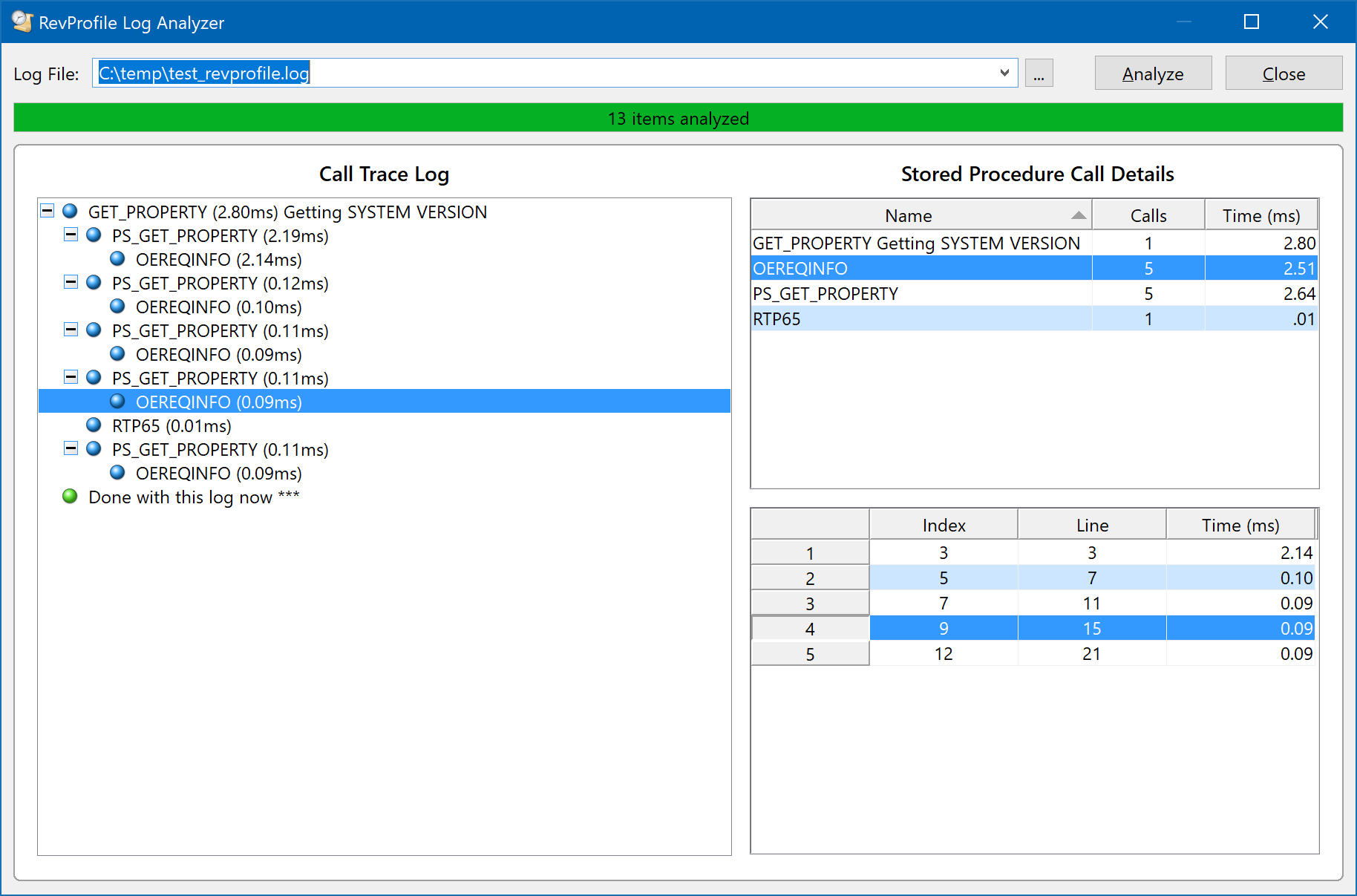
For example, here is the small log file example shown above processed and loaded into the form:

An image of the RevProfile Log Analyzer form (RTI_IDE_ANALYZE_PROFILELOG).

Using this form is fairly simple: just select the log file you want to analyze and wait for the form to parse and process the information. Once this has been done the data from the log is presented in two sections:

  1. The Call Trace Log (on the left), and
  2. The Stored Procedure Call Details (on the right)

The Call Trace Log

This is a TreeListBox control that shows the sequence of calls along with the time taken for that call. It mirrors the structure of the actual log file and displays text notes using a different icon (a green globe), rather than the blue one used for stored procedure calls.

Double-clicking on a stored procedure call selects it in the Stored Procedure Call Details section on the right.

The Stored Procedure Call Details

This section comprises two EditTable controls:

  • The top one contains a list of all the stored procedures found in the log, along with the number of times each was was executed and the total time spent executing.
  • The bottom one details the individual calls to the selected stored procedure – each entry in the table shows the index of the call in the Call Trace Log, the line number in the actual log file where the call was recorded, and the time taken by that call. Double-clicking a call selects the matching entry in the Call Trace Log opposite.

Things to note

  • Both edit tables support sorting via double-clicking on the appropriate column header.
  • Annotated stored procedure calls (i.e those with a note added to them via the RevProfileLog “Set Note” method) are separated from calls to the same stored procedure that are not annotated. This is to ensure that it is easy to isolate and find them in the output.

Very large log files – a cautionary note

RevProfile log files can grow rather large, especially the “static” log files that record the entire lifetime of the application. Whilst these files can be easily read and parsed in smaller chunks, representing their call trace structure in a something like a TreeListBox control can be challenging due to the time taken to load items. For example, something like a 15MB log file with nearly 200,000 calls may take several seconds to appear in the control once the log has been parsed and we set the control’s LIST property (i.e. “Loading call trace list …” appears in the progress bar), and the UI may appear frozen. This is not the case – if you are loading a very large file be sure to exercise a little patience before you reach for the Task Manager!

Conclusion

The new RevProfileLog function provides much better and much-needed profile logging functionality to OpenInsight, making the information much easier to use, and we’re sure it will help you improve the performance of your applications.

(This functionality is available in OpenInsight 10.2 from the Beta 3 release onwards)

(Edit 26 Jun 24 – Corrected name of analyzer form)

EditTables – The CELLPOSCHANGED event

OpenInsight 10.2 adds a new event called CELLPOSCHANGED to the EDITTABLE control. This is effectively the same as the normal POSCHANGED event but with the addition of an extra parameter called “ContextFlags” that provides more information on why the event was raised.

bForward = CELLPOSCHANGED( CtrlEntID,   |
                           CtrlClassID, |
                           NextColumn,  |
                           NextRow,     |
                           ContextFlags )

ContextFlags is a simple bitmask integer that contains the following flags:

Bit Flag ValueDescription
0x00000001If set then the cell position was changed via a keystroke.
0x00000002If set then the cell position was changed via the mouse.

Equates for these flags can be found in the PS_EDITTABLE_EQUATES insert record:

Equ PS_EDT_CTF_NONE$         To 0x00000000;
Equ PS_EDT_CTF_KEYSTROKE$    To 0x00000001;
Equ PS_EDT_CTF_MOUSECLICK$   To 0x00000002;

Example – testing to see if the position (CARETPOS) was changed via a mouse click:

$Insert PS_EditTable_Equates

If BitAnd( ContextFlags, PS_EDT_CTF_MOUSECLICK$ ) Then
   // CARETPOS was changed by using the mouse.
   ...
End

Notes on using the CELLPOSCHANGED event

  1. The default promoted system CELLPOSCHANGED event handler performs the same processing as the default promoted system POSCHANGED event handler (i.e. data validation and required checking etc).
  2. If a CELLPOSCHANGED event handler is defined by the developer then a standard POSCHANGED event will not be raised.
  3. To preserve backwards compatibility with existing applications the default promoted system CELLPOSCHANGED event will not be compiled into a control if there is no CELLPOSCHANGED quick event handler. This is to ensure that POSCHANGED is always executed if CELLPOSCHANGED has not been explicitly set for a control by the developer.
  4. CELLPOSCHANGED is available in OpenInsight 10.2 from the Beta 3 release onwards.

Migration tool updates in OpenInsight 10.2

Based on user feedback (and our own experience) version 10.2 includes the following new updates for the OpenInsight migration process that we think you’ll find invaluable when moving your applications:

  • The ability to choose individual migration tasks
  • The ability to select individual entities
  • The ability to migrate SYSPROG components

We’ll take a look at each of these features below, along with a small note on “migrating” your data.

Task Selection

In previous releases the Migration Tool had a fixed set of tasks to perform which it did in sequence. In this release you may now specify which tasks you wish to execute instead, which might save some time if you have to repeat the migration process more than once (a common requirement if needing to keep a version 9 application synchronized with version 10 during upgrade development).

Migration Tool Selection Page

By default all tasks are selected, but you may deselect any that you don’t wish to run.

TaskDescription
Migrate App SettingsMigrates information from the SYSAPPS record.
Migrates database environment settings.
Migrates custom event (CFG_EVENTS) settings.
Migrate UsersMigrates user details into the SYSUSERS table.
Migrate DLL PrototypesMigrates “DLL_” records in SYSPROCS to DLLPROTOTYPE entities.
Migrate C-StructuresMigrates “STRUCT_” records in SYSOBJ to DLLSTRUCT entities.
Migrate Promoted EventsMigrates promoted event records in SYSREPOSEVENTS/EXES to PROMOTEDEVENT/EXE entities.
Migrate RDK recordsMigrates SYSREPOSVIEWS/RELEASES records to REPVIEW/RELEASE entities.
Migrate EntitiesMigrates application entities. Note that these can now be specified individually if desired (see below).
Migrate Arev32 recordsMigrates Arev32-specific records in SYSENV.
Migrates Arev32 records from SYSPRINTERS.
Clean RelationshipsRemoves invalid relationships (Using/Used By).
Compile Stored ProceduresCompiles migrated stored procedures.
Compile Promoted EventsCompiles migrated promoted events.
Compile FormsCompiles migrated forms.
Migration Tool Tasks

Entity Selection

If you choose the “Migrate Entities” task then you now have the option to select individual entities to migrate (If you don’t select any then all entities in the v9 application will be migrated).

To select individual entities right-click on the “Selected Entities” control and choose “Select Entities” from the menu, or click the “…” options button in the top-right of the control’s header:

Selected Entities option button

You may now use the “Select Repository Entities” dialog to choose which entities you wish to migrate:

Select Repository Entities dialog

As you can see there are quite a few options you can use to find the entities you wish to migrate – these options make a “repository filter” that is used to create a list to choose from:

OptionDescription
Filter IDName of a saved filter (REPFILTER entity). Choosing a filter will load the other selection criteria controls in this dialog with the saved filter details.
View IDName of a saved Repository View (REPVIEW entity). If specified, the list of entities in this View is used as a starting point for the filter when it executes.
Entity IDIf specified only entities matching this name will be selected. The standard ‘[]’,’]’ and ‘[‘ RList-style syntax for “containing”, “starting with” and “ending with” is respected.
Date FromIf specified only entities updated from this date will be included. This option supports a “nD” syntax where “n” is the number of days since the current date. E.g. to select entities updated since the previous day specify “1D”, for entities updated in the last week specify “7D” and so on.
Date ToIf specified do not include entities after this date. This option supports the same “nD” syntax as the “Date From” option.
Updated ByIf specified then only entities updated by the specified user(s) are returned. This option may contain a “,” delimited list for matching against multiple users.
Filter OptionsOnly entities matching the checked options will be returned. Note that for a migration operation the “Show Inherited Entities” checkbox is always disabled (This dialog is used elsewhere in the system to select repository entities, so it can be enabled in such scenarios).
Filter By TypesAllows you to choose specific entity types and classes to include. If blank then all types and classes are included in the search. Click the “…” options button in the top right corner of the control, or right-click to use the context menu to launch a dialog to select the types and classes.
Filter By SELECTThis option allows you to enter an RLIST SELECT statement against the SYSREPOS table that will be used to filter the entities.
Save FilterClick this button to save the filter criteria for future re-use (stored as a REPFILTER entity in the repository).
Apply FilterClick this button to execute the filter criteria and load a list of matching entities into the “Available” controls below. If you have not entered any criteria then all entities in the v9 application will be selected.
Filter Options

Once you have applied your filter the “Available Types” control is populated – selecting a Type populates the “Available Entities” control where you can select the items that you wish to migrate. Use the “>” and “>>” buttons to add them to the “Selected Entities” control on the right, or the “<” and “<<” buttons to remove them.

Selecting Entities in the dialog

Things to note:

  • As items in the “Available Entities” control are selected, the list of items that they use is shown in the “Related (Used By) Entities” control below. These can also be selected if you wish.
  • Each of the “Available” and “Selected” controls have context menus and “…” options buttons (top-right corner).
  • If the “Auto-Add Executable” option is checked when you add entities to the “Selected Entities” control then any executable versions of the entity (e.g. STPROCEXE, OIWINEXE etc) are also added.
  • If the “Auto-Add Source” option is checked when you add entities to the “Selected Entities” control then any source versions of an executable entity (e.g. STPROC, OIWIN etc) are also added.

Clicking “OK” takes you back to the main migration form where you will see the list of entities selected. From there you may click the “Next” button to start the migration process.

(Note that the task and entity selections are saved automatically between migrations so that you may use them again if you wish.)

Migrating items from SYSPROG

Previous versions of the migration tool prevented migrating any entities from the SYSPROG application. This was to preserve the system from being damaged in case older v9 entities overwrote the v10 ones, thereby rendering it unusable.

With this release you may run the migration form from your SYSPROG application with the following restrictions:

  • You may only execute the following tasks:
    • Migrate RDK Records
    • Migrate Entities – You must specify the entities to migrate – you cannot migrate “All Entities”!
    • Migrate Arev32 Records
    • Clean Relationships
    • Compile Stored Procedures
    • Compile Forms
Migrating SYSPROG options

Bonus Trivia – a quick note on migrating data

The migration process begins with creating a new application in version 10 and then executing a form called RTI_MIGRATE_V9_TO_V10, which guides you through the steps necessary to move your application from version 9.

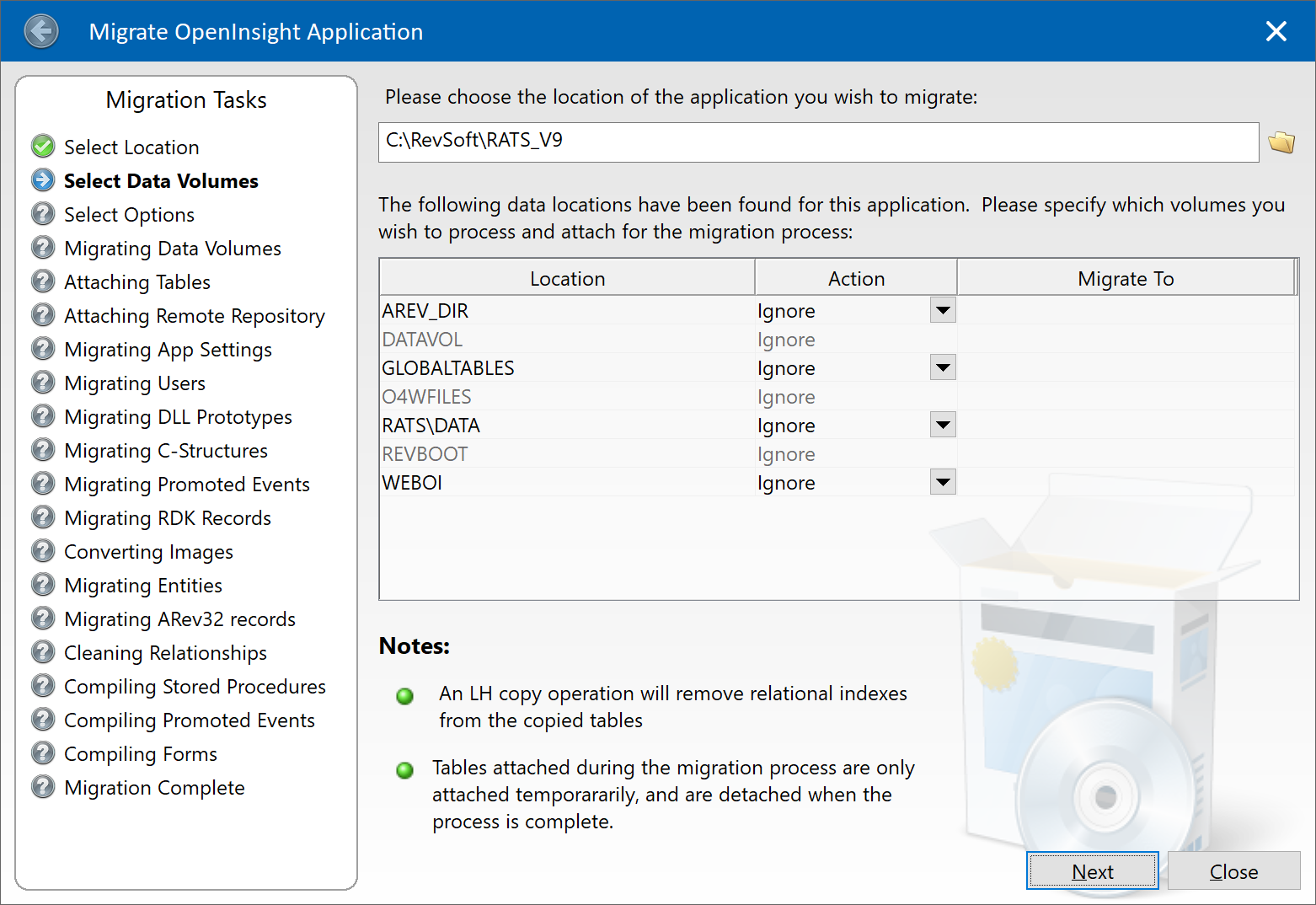
Migration Tool Start Page

At this point you select the location of the application you are migrating from, after which you see the data volumes that are attached in it. There are options for the data to be “migrated”, but in my experience it is best to move and attach the data you want for your application before you attempt the migration rather than use the facility here. The migration process does not change your data at all so there is no real advantage to using this facility (it is basically provided as a convenience), and in fact, if you are moving tables containing relational indexes they will be removed. It is far easier to copy/move and attach the tables yourself using the Database ToolPanel before you get here.

More Bonus Trivia – Sharing index data between v9 and v10

While on the topic of migrating data it is also worth taking a look at the end of this blog post by Sprezzatura if you intend to share your tables between v9 and v10 systems – you must make sure that you run the indexing system in a v9 compatible format:

   Indexing Issues In Large Tables

Conclusion

The migration tool has been significantly improved for the version 10.2 release and we’re sure you will find it much more helpful when moving your older applications to the latest version of OpenInsight.

ListBoxes and TreeListBoxes – “in-place” editing

One of the new features that was added to the ListBox and TreeListBox controls in version 10 was the ability to use “in-place” editing on the items in the same manner as the Windows Explorer when you press “F2” or double-click an item. If you’ve done any work with the OpenInsight Menu Designers you will have seen this capability in action.

In-place editing for an item

The READONLY property

Enabling in-place editing is as simple as setting the READONLY property to False – once you’ve done that the user can press “F2” while using the control and edit the text of the currently selected item.  Pressing “Enter” when editing will update the item text (as will losing focus or selecting another item), while pressing “Esc” will abandon the changes.  Obviously that’s a very simple take on the topic and hardly worth a blog post in and of itself, so next we’ll take a look at some of the properties, methods and events that you can use to tailor the editing process.

The EDITING property

This is a simple boolean property that returns TRUE$ if an item is being edited.

The EDITORHANDLE property

This property returns the HANDLE of the editor control if an item is being edited.

The EDITKEY property

By default, hitting “F2” on an item puts the control into “edit mode”, just like the Windows Explorer.  However, if you wish to change this then you may use the EDITKEY property to select another key instead. The edit key is a Windows virtual key code and constants for these codes can be found in the MSWIN_VIRTUALKEY_EQUATES insert record.

The EDITOPTIONS property

This property allows you to fine-tune some of the validation options for the editor:

  • TextCase – Specifies if the text entered is lower-case only, upper-case only or mixed (See the EDITLINE TEXTCASE property for more details).
  • ValidChars – Specifies which characters may be entered into the editor (See the EDITLINE VALIDCHARS property for more details).
  • MaxLimit – Specifies the maximum number of characters that may be entered into the editor (See the EDITLINE LIMIT property for more details).

At runtime this property is an @fm-delimited array – constants for use with this property can be found in the PS_LISTBOX_EQUATES insert record.

The INCLUDEEDITORTEXT property

By default getting item text from the ListBox (e.g. via the LIST property) will include the text from an item currently being edited, even if that edited text has not yet been saved.  Setting this property to FALSE$ ensures that the returned item text ignores the value in the editor instead.

The BEGINEDIT method

This method allows you to programmatically put the ListBox into edit mode, as if the user had pressed “F2” (or whatever value the EDITKEY property is set to). You may specify the index of the item to edit, otherwise it will default to the current item.

RetVal = Exec_Method( CtrlEntID, "BEGINEDIT", itemIndex )

The ENDEDIT method

This method allows you to programmatically stop the item editing process, optionally allowing any changes to be accepted as if the “Enter” key had been pressed (the default is to reject any changes as if the “Esc” key had been pressed).

RetVal = Exec_Method( CtrlEntID, "ENDEDIT", bUpdate )

The ITEMEDITING event

This event is raised when an item it put into edit mode, and passes the index of the item as a parameter:

bForward = ITEMEDITING( CtrlEntID, CtrlClassID, ItemIndex )

The ITEMCHANGED event

This event is raised when the item is updated via the editor, i.e. the user hit the “Enter” key, the control lost the focus, or the EDITEDIT method was used with the bUpdate parameter set to TRUE$. The event passes the index of the item that has changed as well as the old and new data:

bForward = ITEMCHANGED( CtrlEntID, CtrlClassID, ItemIndex, |
                                                NewData,   |
                                                PrevData )

The ITEMUNCHANGED event

This event is raised when an item leaves edit mode without being updated, i.e. the user hit the “Esc” key or the EDITEDIT method was used with the bUpdate parameter set to FALSE$. The event passes the index of the item that was being edited:

bForward = ITEMUNCHANGED( CtrlEntID, CtrlClassID, ItemIndex )

So that wraps up this short post on ListBox editing – we’re sure that you’ll find many useful ways of implementing this new feature when expanding your application’s functionality.